Because your attention span is trained, not fixed — and years of 15-second content trained it to expect a new reward every few moments. Ten minutes into one task, your brain starts demanding the stimulation change it's used to. The fix is progressive retraining: timed sessions starting at 10–15 minutes, phone in another room, adding ~5 minutes weekly. Most people rebuild to 45+ minutes within a month.
What actually happened to your attention
You used to read for hours as a kid; now a 4-minute video feels long on 1× speed. Nothing in your brain "broke" in between — it learned. Feeds, shorts, and notifications deliver a novelty hit every few seconds, and your dopamine system did what it always does with a reliable payout: recalibrated its baseline around it. Sustained work — flat, slow-paying, reward deferred by weeks — now reads as below baseline, and your brain flags it as a problem to escape roughly every ten minutes.
There's a second cost, and it's sneakier: attention residue. Every "quick check" leaves part of your mind processing what it saw for the next 10–20 minutes. Check your phone four times an hour and you never have a clean hour at all — you have sixty minutes of contaminated fragments. The 10-minute wall isn't one problem; it's these two stacked.
The retraining protocol
Week 1 — Prove 10 minutes is possible again
Two or three 10–15 minute sessions a day, one named task each, phone physically in another room (in your pocket on silent doesn't count — its presence alone drains working memory). The only rule: the session ends when the timer ends, not when the urge hits. You're re-teaching one expectation — focus runs to completion.
Week 2 — 20–25 minutes, urges on paper
Bump to 20–25 minutes (the classic Pomodoro band). Keep a sticky note next to you; when the urge to check something hits, write the thing down instead of doing it — "reply to Dana," "look up that actor" — and return to work. The note closes the mental loop without paying the 20-minute residue tax. Most urges look absurd by the end of the session, which is the lesson.
Week 3 — 30–45 minutes, real breaks
Longer blocks need real recovery between them: walk, water, window — anything without a screen. Scrolling during breaks refills the exact interruption-expectation you're draining. Two clean 45s with real breaks now beat a fragmented 8-hour day.
Week 4 — One deep block, distraction-free by design
Protect one 60–90 minute block at your sharpest hour. For these, the best timer is an invisible one — Resolve's Zen mode is a fullscreen flip clock with nothing to check, no progress to glance at, nothing to fiddle with:
Protect the gains: the inputs that set your baseline
- Night screens are daytime attention's biggest tax. The pre-sleep scroll both cuts sleep (attention's raw material) and books a morning dopamine appointment your work can't match. Fix the night scroll and the daytime numbers move within a week.
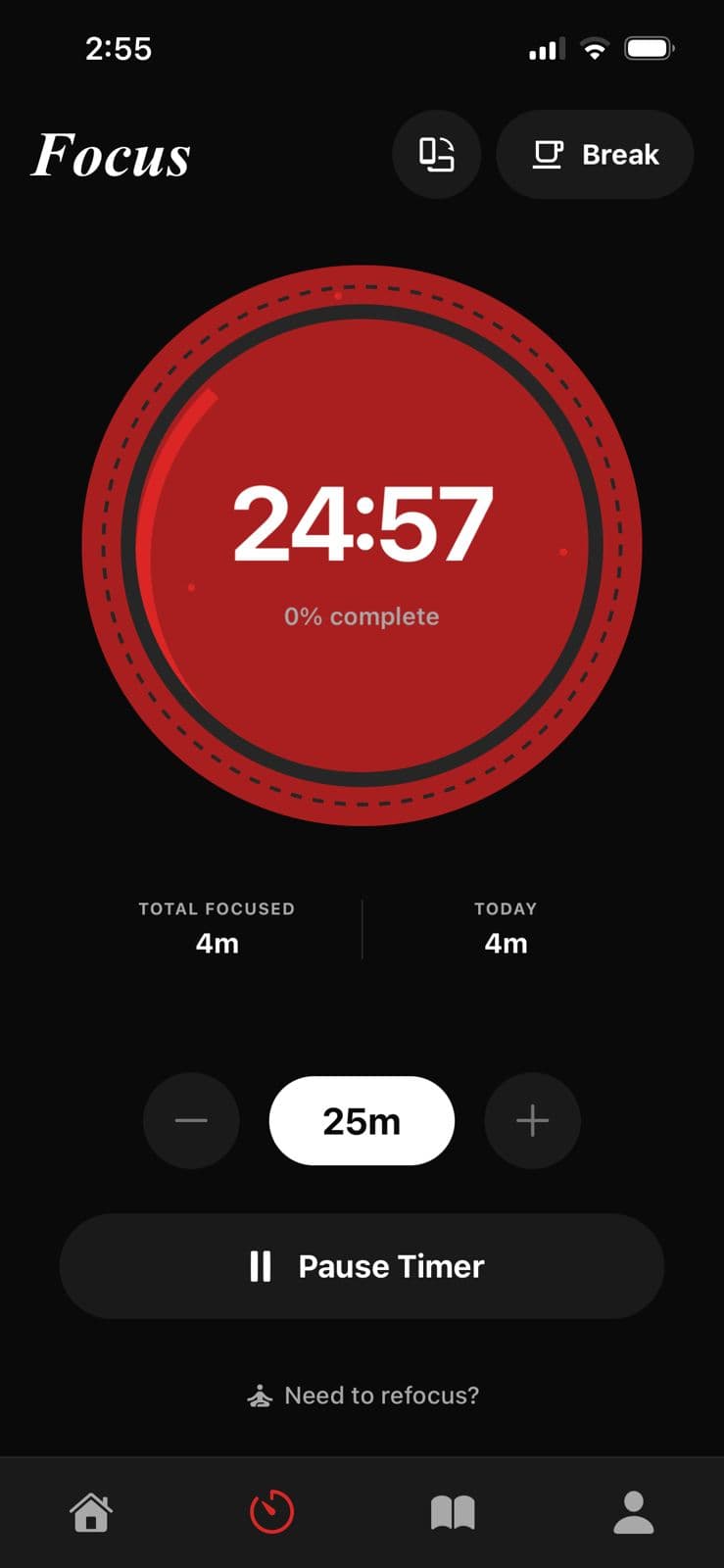
- Track focus time like a habit. Watching a weekly focus total grow does for attention what a streak does for the gym — measurement changes behavior.
- One screen, one task. Dual-screen "multitasking" is task-switching with extra steps, and each switch bills you residue.
- Movement and daylight remain boring, unbeatable baseline raisers — a 20-minute morning walk outperforms most focus hacks on this list.
When it's more than training
If focus problems have followed you since childhood — across school, hobbies, and low-stimulation environments alike — or they come with chronic restlessness and impulsivity, it's worth ruling out ADHD with a professional rather than grinding the protocol harder. Our focus-with-ADHD guide and self-screening are reasonable starting points (screening, not diagnosis). For everyone else: the wall at 10 minutes was built by training, and four weeks of deliberate reps tears it down the same way.
Frequently asked questions
Is my short attention span permanent?
No. Attention span behaves like a muscle: it atrophies under constant interruption and rebuilds under progressive load. People who follow a graduated protocol — short timed sessions, phone out of the room, slightly longer each week — typically sit comfortably at 45+ minute sessions within four to six weeks.
Could it be ADHD instead of phone habits?
It could be either, or both — the honest tell is history and context. ADHD attention struggles appear across your whole life (school, childhood, every environment), not just after years of heavy phone use, and persist even in low-stimulation settings. If focus problems are lifelong and severe, talk to a clinician; a self-screening can help you decide whether to. Either way, the retraining protocol below still helps.
Why can I focus on games and videos but not work?
Because games and feeds are engineered to deliver a reward every few seconds, while work pays out on a delay of hours to months. Your dopamine system follows the better payout schedule. That's also the fix: make work's progress visible and immediate — timers, session stats, a named goal — so the gap in payout schedules shrinks.
How long should my focus sessions be when starting to rebuild?
Start at 10–15 minutes — long enough to stretch you, short enough to finish. The non-negotiable is completing the session without touching your phone, because each completed session retrains the expectation that focus pays off. Add roughly five minutes per week; most people reach a comfortable 45 within a month.
Does caffeine help or hurt focus?
Caffeine raises alertness, which helps focus on tasks you've already committed to — but it doesn't fix a trained-out attention span, and late-day caffeine wrecks the sleep that attention depends on. Treat it as an amplifier of whatever system you have, including a broken one.
Related questions
Matching session length to the work once focus returns.
The evening habit that sets your daytime dopamine baseline.
What 90-minute blocks unlock after the retraining.
When the standard protocol needs adapting.
Start Your Transformation Today
Stop relying on motivation. Build the discipline you need to achieve your goals with Resolve.
 Download on iOS
No Credit Card Required • Free Plan Available