Yes — with unusually strong evidence. Habit tracking is what researchers call self-monitoring, and a meta-analysis of 138 behavior-change studies found it the single most effective technique tested. People who track an outcome consistently outperform non-trackers — in weight-loss studies, by roughly double. The catch: it works through honesty and visibility, so it fails when you track too much or treat streaks as morality.
The evidence, briefly
Habit tracking isn't an app-store invention — it predates phones by decades in the clinical literature as self-monitoring. The highlights:
- Michie et al., 2009: a meta-analysis of 138 healthy-eating and activity interventions found self-monitoring outperformed every other behavior-change technique studied.
- Food-diary research (Kaiser Permanente, ~1,700 participants): people who kept daily food records lost about twice the weight of those who kept none — the act of recording itself changed eating.
- Goal-setting research (Locke & Latham): feedback on progress is one of the strongest moderators of whether goals work at all. Tracking is that feedback loop, self-administered daily.
Why a checkbox changes behavior
1. Measurement ends self-deception. Without a record, everyone "basically works out regularly." With one, you ran 6 of the last 30 days and the graph says so. You can't improve a number you're lying to yourself about — and you can't lie to a grid of squares:
2. The check is a reward the habit can't give you yet. Real results — fitness, savings, a finished thesis — arrive on a delay of weeks to years. The checkmark arrives now. That tiny completion hit bridges the gap between effort today and payoff later, which is exactly the gap where motivation dies.
3. A visible pattern recruits identity. After two weeks of filled squares, skipping stops being "not feeling it today" and becomes breaking something you built. Loss aversion — the brain's outsized hatred of losing what it has — quietly switches teams and starts working for your habit instead of against it.
What good tracking looks like
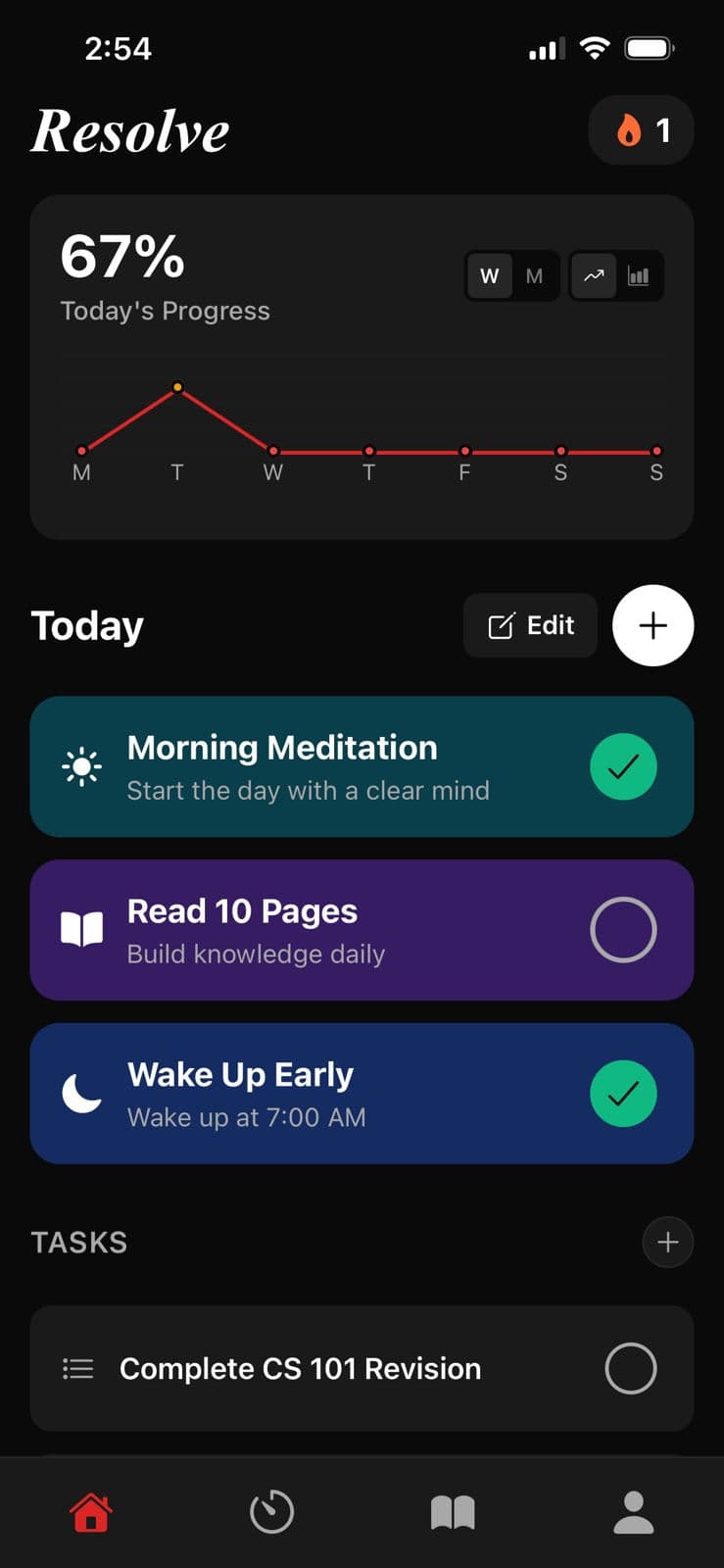
The research points to a specific recipe: few habits, honest weights, instant logging, visible history. Here's that recipe as a screen — three habits weighted by difficulty (so the day's percentage reflects effort, not checkbox count), a one-tap check, and the week's curve right at the top:
The two ways tracking backfires
Backfire #1: tracking becomes the hobby. Fifteen habits, three apps, color-coded spreadsheets — and no actual behavior change. Logging has a cost, and past a handful of habits the cost exceeds the benefit. The fix is brutal curation: 1–3 new habits at a time, everything else archived.
Backfire #2: the streak becomes a judge. Streaks are powerful fuel until the first miss — then, for some people, the broken chain triggers what-the-hell-style abandonment. If that's you, track monthly completion percentage instead of consecutive days, and keep the never-miss-twice rule as your only streak law.
Verdict
Habit tracking works — not as magic, but as the cheapest honest feedback loop you can build. It converts vague intentions into measurable behavior, pays out a reward weeks before the habit itself can, and slowly turns consistency into identity. Keep the list short, the log one tap, and the streak in its place, and the checkbox is worth more than any productivity advice you'll read this year — including this page.
Frequently asked questions
Is there actual science behind habit tracking?
Yes. Habit tracking is 'self-monitoring,' one of the core techniques in the behavior-change literature with hundreds of studies behind it. A landmark meta-analysis of 138 studies (Michie et al., 2009) found self-monitoring was the single most effective behavior-change technique tested, and weight-loss research consistently shows people who track outcomes lose roughly twice as much as those who don't.
Why does just writing something down change behavior?
Three mechanisms: measurement forces honesty (no more 'I basically work out a lot'), recording creates an immediate micro-reward that the habit itself won't deliver for weeks, and a visible record makes today's choice feel like part of a pattern rather than an isolated event you can quietly skip.
Can habit tracking become unhealthy or obsessive?
It can, in two ways: tracking so many things that logging becomes a burden (fix: track 1–3 habits that matter), and treating a broken streak as a moral failure (fix: judge yourself on monthly completion rate, not consecutive days). The tracker is an instrument panel, not a report card.
Do habit tracker apps work better than paper?
The mechanism is identical — both work. Apps win on reminders, streaks that compute themselves, graphs that reveal patterns, and being in your pocket at the moment of truth. Paper wins on zero distraction potential. The best tracker is whichever one you'll still be using in week six.
What should I do when tracking starts to feel like a chore?
Shrink it. Cut the list to your 2–3 keystone habits, make logging one tap, and archive everything that's been automatic for months. If the chore feeling persists, that's usually a sign you're tracking obligations rather than chosen habits — re-pick habits you actually want the identity of.
Related questions
The curation rule that keeps tracking effective.
The gap that tracking's instant feedback bridges.
What to look for if you're choosing a tracker.
How many days of tracking you're actually signing up for.
Start Your Transformation Today
Stop relying on motivation. Build the discipline you need to achieve your goals with Resolve.
 Download on iOS
No Credit Card Required • Free Plan Available